



GTA 6’s mansions and pool houses are part of the way Rockstar presents wealth in Leonida. Waterfront architecture, private pools, terraces, boats, and guarded-looking boundaries create a visible contrast with the state’s more modest homes and working spaces. The most useful question is not simply whether large houses exist. It is what the images establish about those places and what still needs to be checked before calling them purchasable properties, safehouses, or enterable interiors.
This guide examines the luxury-home imagery as setting and explains how to evaluate practical property claims. It does not provide an invented mansion price list or claim hands-on access to every building. A home visible in official media is evidence of a location in that scene. Ownership, interior access, storage, customization, and story use are separate features. The generated images accompanying the article are imagined editorial illustrations, not architectural records or screenshots of actual GTA 6 properties.
The clearest waterfront property scene
A published description of the launch-gallery image identifies a canal-side mansion with a pool and yacht, alongside police on a bridge, a police boat, and a helicopter. That combination places luxury architecture within a larger action scene rather than presenting it only as scenery. It is a useful example of how a private waterfront property can become a dramatic setting.
The description does not identify a purchase price, a player ownership menu, or a complete interior. It also does not establish whether the yacht and house form a single asset. Treat the property as a shown setting with a described context. A future location guide should connect the scene to a verified in-game name and a route, while a buying guide should separately document the transaction. Combining those tasks too early is how a recognizable house becomes an unsupported promise of a new safehouse.
Mansions communicate more than size
A large house can signal wealth through its relationship to its surroundings: distance from the street, private access, landscaping, water frontage, and spaces intended for leisure. A pool or terrace makes that message particularly readable because it shows land and architecture devoted to comfort rather than necessity. This is an architectural interpretation, not a list of confirmed interactive systems.
That distinction helps explain why luxury homes matter even if a particular property is not available to buy. They can establish who has money, who is excluded, and how different parts of the city present themselves. A gated façade and an open waterfront terrace create different public faces for the same imagined owner. When exploring, look at those relationships rather than treating every large building as a potential reward. The environment can tell a story before an objective or purchase prompt appears.
A pool house is not automatically a second residence

“Pool house” can describe a separate structure serving a swimming pool, an outdoor entertainment area, or a small building within a larger property. In a screenshot, a low structure beside water may resemble one without revealing its actual function. A guide should be careful about assigning a label when the game has not supplied it.
Even when the structure is clearly associated with a pool, that does not prove it contains an accessible interior, a bed, a changing area, or a storage function. Those details need observation. For readers interested in property features, the useful question is what action the building supports. Can the player enter, interact, save, change clothes, or simply walk past it? Each answer has a different practical meaning. A beautiful poolside structure should not become a second safehouse in a guide merely because the phrase sounds appealing.
Exterior appearance does not establish interior access
A detailed exterior can make a home feel substantial without revealing how much of it is accessible. Windows, balconies, and doors may suggest rooms that the player cannot enter, or they may lead into a space used only during a particular sequence. A still image cannot reliably distinguish those possibilities.
A useful interior guide should identify the entrance, the condition under which it opens, and the areas actually explored. If access occurs only during a mission, the guide should say so. If a property changes after a story event, that change needs a spoiler boundary. Readers should not have to discover halfway through an article that the author’s interior screenshots came from a different stage of the game. Exact access context is more helpful than an inflated count of “enterable mansions” assembled from pictures of rooms and façades that have not been connected.
Buying a home requires transaction evidence
This research pass did not verify a complete mansion marketplace, purchase catalog, or property price table. Visible luxury homes do not establish that every example can be bought. Nor does a character owning real estate establish that the protagonist can buy the same kinds of assets through the same process.
A trustworthy property-buying guide should show the relevant interface or interaction, the price, the unlock requirement, and what the player receives. It should distinguish a purchase from a story-provided residence, temporary access, rental, or mission location. The meaning of “own” also needs explanation: does the property persist, offer storage, provide a useful function, or simply change a story flag? Those details determine value. A guide that skips them in favor of a large photograph may be visually attractive while leaving the reader unable to make an informed decision.
Safehouses and mansions are different categories
A safehouse is defined by its role for the player, while a mansion is primarily an architectural description. A modest residence can serve an important gameplay function, and an enormous home can remain a story location or background setting. Treating the terms as synonyms makes property coverage less precise.
For a practical safehouse entry, identify the functions that are actually available and the progression context. Do not assume saving, wardrobe access, vehicle storage, or fast travel simply because those features appeared in another game. If a location is provided through the story, explain when it becomes available without unnecessarily spoiling later events. The luxury-home question can then remain focused: which large residences have been shown, what do they communicate about the setting, and which practical functions have been independently checked? That separation helps both explorers and players looking for a specific utility.
Character property connections are story context
Rockstar’s character material describes Boobie Ike’s legitimate empire as spanning real estate, a strip club and a recording studio, and places Brian Heder’s operation at a boat yard in the Keys. These are concise story relationships, not a published catalog of homes available to purchase. They show that property is part of Leonida’s social and economic world without defining a universal ownership system.
The distinction matters because character wealth can be easy to confuse with player progression. A person possessing several buildings does not establish a management feature, passive-income system, or purchasable business chain. A guide should explain the relationship the source actually states and then document any gameplay feature separately. If a later mission involves a property transaction, that can be added with the relevant evidence. Until then, keep biographies as context for understanding the setting rather than using them to predict a real-estate simulator.
Pools can be scenery, space, or an activity setting
A pool creates a recognizable leisure environment. It can frame a social gathering, establish the scale of a property, or provide a visual contrast between clear water and surrounding architecture. Those are observations about what a pool contributes to a scene. They do not establish every interaction a player can perform there.
For a pool-focused guide, useful questions include whether the area is accessible, whether it belongs to a private home or public venue, and what interactions are actually offered. A hotel pool should not be counted as a purchasable mansion feature. A private pool in a mission should not become a guaranteed free-roam destination without checking access. When comparing images, pay attention to the surrounding building and landscaping as well as the water. Similar-looking leisure spaces can belong to very different kinds of locations.
Waterfront homes connect roads and waterways
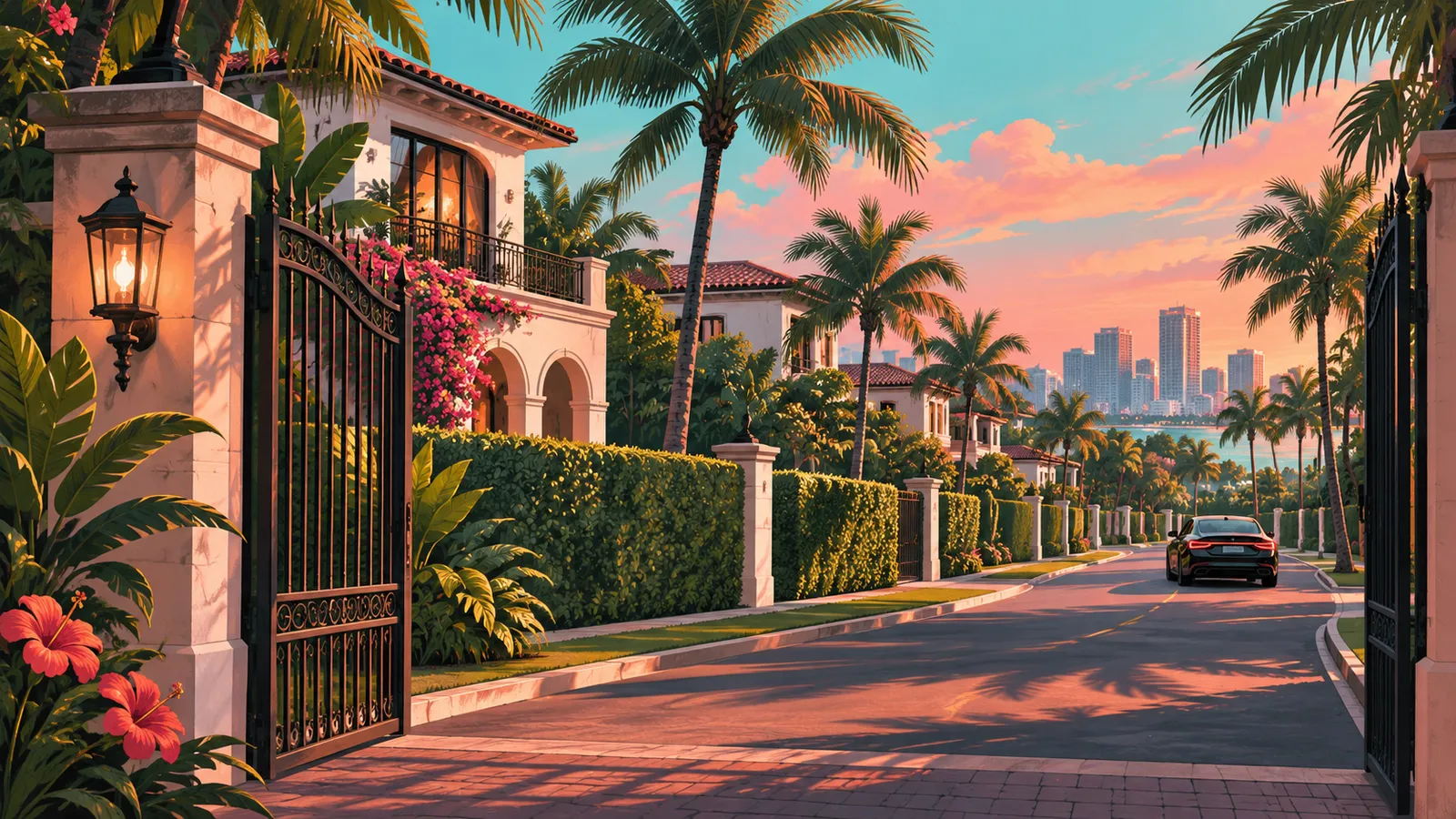
A canal-side property can have several visually distinct approaches: a street-facing entrance, a garden boundary, and a dock or terrace facing the water. That makes waterfront architecture particularly interesting in a game about movement through a coastal state. It also makes location identification more demanding because two views of the same property can look unrelated.
For a reliable guide, connect the approaches through verified landmarks rather than assuming that a dock beside a mansion must be publicly accessible. The yacht and luxury boat guide explains why a nearby vessel does not establish ownership or control. The same principle applies to docks: their presence does not tell us whether they function as storage, an activity start point, or scenery. A useful map should label only the access routes and interactions that have actually been checked for that location.
Security imagery does not define burglary mechanics
Police, gates, cameras, or guards can create a sense of security around a property. They do not automatically establish a general home-burglary system or a repeatable mansion robbery activity. A story mission can use security imagery for a particular encounter without making every similar building a target.
If a guide offers burglary instructions, it should identify the exact property, starting condition, objective, and result. It should separate a mission-specific route from a general open-world method. It should also avoid treating decorative objects as working systems without evidence. A camera-shaped object on a wall does not prove a detection zone; a locked-looking gate does not establish a lockpicking interaction. This is not a reason to ignore environmental clues. It is a reason to use them as clues until the game demonstrates the rule that makes them actionable.
How to judge a mansion location map
A good location map should tell you what the pin represents. Is it the front entrance, a viewpoint, a mission marker, a purchased property, or an approximate sighting? Those are different destinations. If the map is community-made, its status should be clear rather than presented as official geography.
For each property, look for a name or reliable description, a nearby fixed landmark, and a statement of access. If the guide uses a photo taken during a mission, check whether the same route is available outside that mission. Vertical differences matter as well: a waterfront terrace, road bridge, and canal can overlap on a flat map while being difficult to reach from one another. The most useful guide explains the final approach and the purpose of the visit. A large collection of unlabeled pins can create more confusion than a small number of well-documented locations.
Luxury design is part of the story’s contrast

GTA 6’s official premise places Jason and Lucia within a criminal story stretching across Leonida. Luxury homes fit naturally into a setting concerned with money, aspiration, and unequal access to comfort. That is a thematic reading, not a claim about the protagonists’ final residence or the outcome of their story.
A poolside terrace can represent a destination someone wants to reach, a world they do not belong to, or a setting that turns out to be less secure than it looks. The image does not need to reveal which role it plays for the contrast to work. This is why property coverage can be useful without an invented purchase list. It helps readers notice how architecture and status are presented while preserving the distinction between interpretation and a practical guide to what the player can actually acquire.
Record the purpose of a property visit
When saving a location for later, note why it interested you. A viewpoint, a mission entrance, an accessible interior, and a usable player property are different kinds of discovery. Labeling the purpose keeps a personal map useful and prevents a sightseeing pin from being mistaken for a shopping recommendation. Include a nearby landmark and the approach you used, especially when the home faces both a road and a canal.
If access changes, record the story context rather than immediately assuming the location is broken. A building used during one sequence may have different rules later. These notes are particularly helpful when comparing community guides, because two apparently conflicting reports may describe different visits. Specific observations let an editor resolve that difference without inventing a universal rule about every luxury home in Leonida.
Frequently asked questions about luxury homes
Have large waterfront homes and pools appeared in the reviewed material? Launch-gallery descriptions identify such a setting. Can every mansion be entered? Exterior imagery does not establish access. Can you buy a mansion? This article does not provide a verified general purchase system or price list. Does a yacht beside a home come with it? The scene does not establish a bundle.
Is every large house a safehouse? No; a practical safehouse function needs its own evidence. Are the illustrations exact properties? No. They are imagined editorial artwork and must not be used for navigation. Will this guide become a property directory? The useful next step is a checked list of names, locations, access conditions, and functions. Those additions should be based on the game’s actual interactions. Until then, Leonida’s luxury homes are best understood as distinctive places within the world, with ownership and utility documented individually rather than assumed from appearance.