


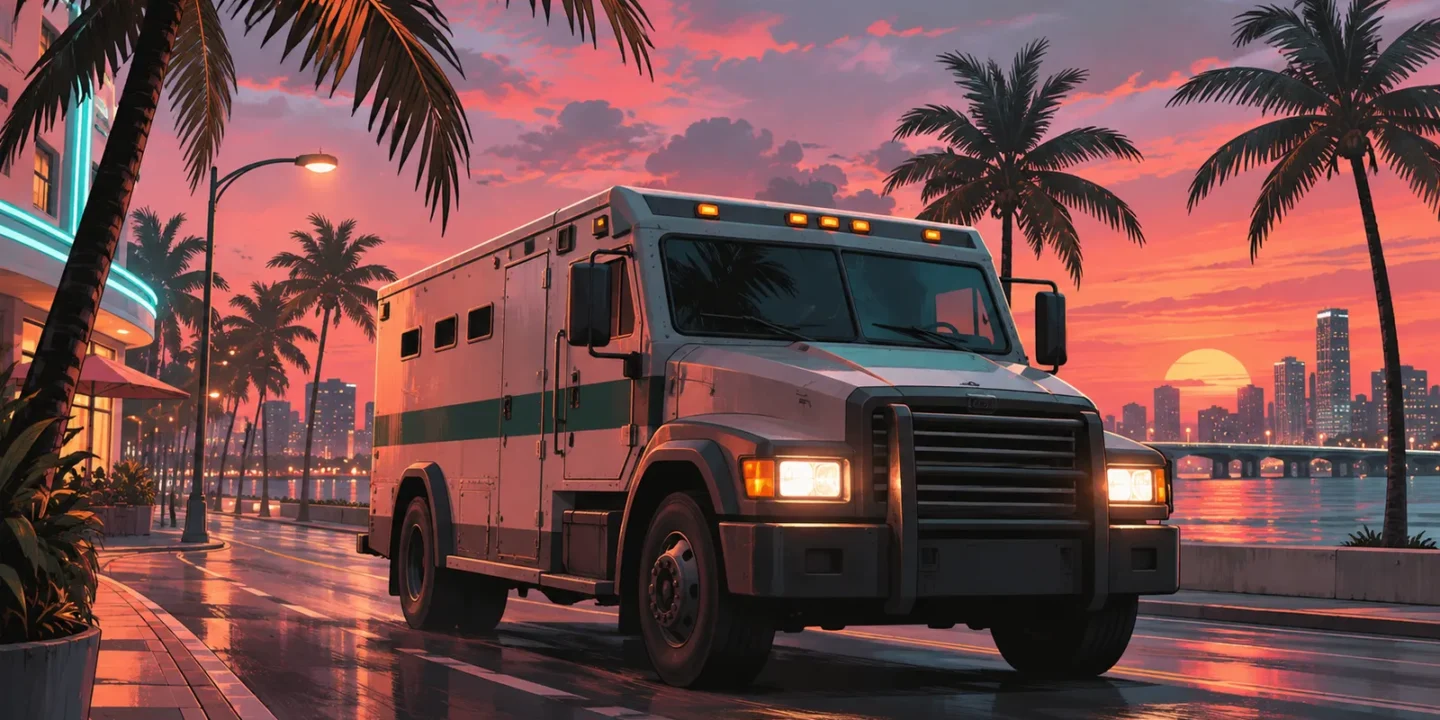
The GTA 6 armored truck scene brings Jason, Lucia, police, and a Gruppe Sechs security vehicle into the same action sequence. It is an obvious subject for players interested in heists, but “the Gruppe Sechs heist” is a descriptive label here, not a verified mission title. The material reviewed for this article does not supply a tested unlock requirement, payout, truck spawn route, or repeatable robbery method.
What it does support is a closer look at the security truck encounter and the questions that distinguish a story set piece from an open-world money opportunity. This guide follows that evidence carefully. You will find an explanation of the scene, the role of the security brand, the limitations of a single image, and a practical framework for judging any walkthrough that claims to tell you how the robbery works. No hands-on completion or vehicle testing is claimed.
What the official gallery scene shows
Rockstar’s own launch-gallery caption describes Lucia leaning over the passenger seat and shooting an assault rifle while Jason drives toward a Gruppe Sechs security truck, with several patrol cars on sirens and armed police shooting at a crew of robbers. Together, those descriptions place a security vehicle within an active street confrontation involving the protagonists.
That is narrower than a complete account of the job. It does not tell us whether the truck is the initial target, a vehicle encountered during an escape, or part of a larger mission. The picture also cannot establish whether its doors open, whether money is removed from it, or whether a player can reproduce the same confrontation outside a mission. The truck’s presence is concrete; the complete heist structure still needs a continuous sequence or tested objective record.
What Gruppe Sechs means in this context
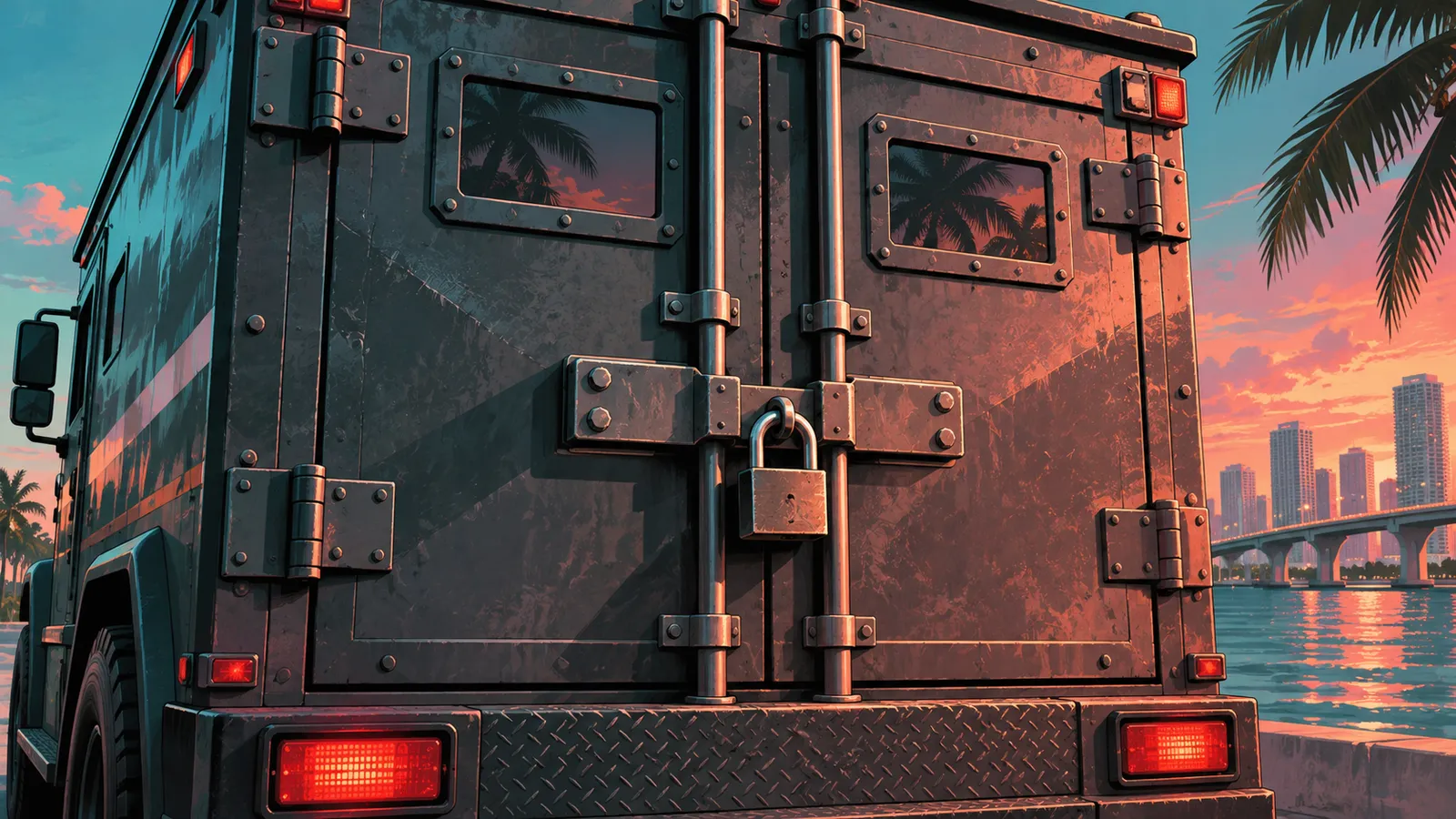
Gruppe Sechs is the fictional security name associated with the truck in the gallery description. For players, the useful distinction is between the company name and the vehicle’s gameplay behavior. A security vehicle can be visually recognizable without having the same armor, access rules, or cargo behavior as another vehicle bearing that name in an earlier Grand Theft Auto game.
The brand also does not prove the value of whatever might be inside. A cash transport vehicle is an understandable visual shorthand for a robbery target, but a game may use it as scenery, a moving objective, a mission prop, or a vehicle with specialized interactions. Those possibilities require different advice. A guide should describe the interaction actually demonstrated rather than converting the company’s business identity into a list of assumed gameplay features. Recognition starts the investigation; it does not finish it.
Why the word “heist” needs context
Players use “heist” broadly to describe a planned robbery, a cinematic crime sequence, or a structured mission with preparation and a finale. Those meanings overlap, but they are not interchangeable when you are looking for instructions. A truck confrontation could be a short objective inside a longer story mission rather than a separate activity with its own setup board or crew selection.
This page therefore uses the user-facing term without claiming a particular mission format. A full walkthrough should state whether there are preparatory tasks, which objectives are mandatory, and where the event appears in the mission list. It should also explain whether “armored truck robbery” is the game’s wording or the author’s label. That small clarification prevents readers from searching menus for a title that was never officially assigned to the encounter.
Jason driving does not settle character switching
The driver’s position gives the scene a strong sense of motion. Lucia’s involvement adds another perspective on the same confrontation. Neither detail, on its own, establishes whether the player must drive, shoot, switch characters, or follow an automated segment at that exact moment. An action image can depict characters performing tasks without explaining which tasks are controlled directly.
For that reason, a useful guide needs to identify the active character at each stage. If the game changes perspective automatically, the instructions should say when that occurs. If switching is optional, that should be distinguished from a mandatory transition. Without those details, advice such as “switch to Lucia here” can sound precise while remaining completely unverified. The broader partnership is central to GTA 6’s official premise, but the control scheme for one encounter deserves its own evidence.
A roadside target is different from a fixed bank
An armored vehicle changes the spatial problem presented by a robbery scene. A bank has a fixed building and a recognizable interior. A truck can appear on a road, near intersections, among traffic, or beside police vehicles. These settings create different visual opportunities for an action sequence. They do not automatically establish a free-roaming convoy system.
The useful comparison is environmental. A fixed interior may emphasize room layout and scripted interactions; a street scene may emphasize movement, sight lines, and the relationship between vehicles. These are observations about the kind of space shown, not tested tactics. For the bank scene itself, see our Fleeca robbery analysis. Keeping those pages separate avoids treating all robbery imagery as evidence for a single universal system that has not been demonstrated in the material reviewed here.
Can you find the truck in free roam?

The scene does not establish a free-roam spawn location, schedule, route, or frequency. A mission vehicle may be placed only when a particular objective is active. A vehicle encountered elsewhere may use different access rules. Even if players later discover the same model in traffic, that discovery would not necessarily recreate the money opportunity depicted in the promotional sequence.
A reliable free-roam report should identify the region, nearby landmarks, game mode, story progress, and whether a mission was running. Repeated observations are more helpful than a single map pin. If the event appears only after a phone call or another trigger, the trigger belongs in the instructions. Until that context is available, avoid spending time circling a claimed spawn route solely because a screenshot shows a security truck on a road that looks similar.
What would prove that the truck can be robbed?
The strongest evidence would show an interaction that leads from encountering the truck to obtaining a reward. That could include an objective naming the truck, an interaction prompt, a visible transfer of cargo, and a completion notification. The exact sequence matters because damage to a vehicle is not the same as a successful robbery, and entering a vehicle is not the same as collecting a reward.
A good guide should identify the minimum required action and separate it from optional spectacle. It should not assume that a dramatic explosion is necessary because the vehicle looks armored. Nor should it claim that a particular weapon is mandatory without testing the mission’s alternatives. Readers need a reproducible path through the game’s rules. A thumbnail showing a truck surrounded by action can establish the subject, but it cannot establish the solution.
Rewards should be measured after the encounter resolves
For an armored truck guide, the phrase “payout” should refer to a clearly defined result. Is the guide measuring money collected from the vehicle, the total mission payment, or the change in a protagonist’s balance after a story sequence? Without that definition, two apparently conflicting figures may simply describe different stages of the same encounter.
This article supplies no tested reward figure. A later reward section should record the starting balance, mandatory expenses, optional pickups, and final retained amount. Completion time should begin at a stated point as well. Timing only the final action while omitting travel or setup produces a misleading money-per-minute calculation. If a guide ranks armored trucks against other activities, it should compare full cycles under similar conditions rather than using the most exciting few seconds of each.
Police presence does not reveal a universal wanted level

Police in the scene establish an active confrontation. They do not establish a fixed star count, response timer, or statewide rule for attacking security vehicles. A story sequence can summon police through scripting, while an open-world event may follow a broader detection system. These mechanisms can produce similar-looking action but require different explanations.
For practical help, look for a guide that identifies the condition needed to advance. Reaching a destination, losing a pursuit, protecting another character, or surviving a timed segment are different objectives. If a player is stuck because an objective marker has not updated, general advice about hiding from police may miss the problem. Our police and wanted system guide covers the larger topic, while a truck-specific walkthrough should document only the response and completion conditions actually observed during this encounter.
Vehicle damage and cargo access are not the same system
An armored truck’s visual design suggests reinforced doors and heavy bodywork, but an image does not reveal its damage model. It also does not reveal whether different parts of the vehicle respond differently. Claims about bullet resistance, tire behavior, door strength, or explosive requirements need direct tests or explicit documentation.
The same caution applies to cargo. A rear door opening in a cinematic would not necessarily establish an interaction available on every truck of that type. A useful guide should state whether access happens through a prompt, an objective, a cutscene, or ordinary vehicle interaction. It should also say whether the cargo survives alternative approaches. These details affect whether a suggested method is reliable. The safest editorial approach is to explain the verified interaction first and discuss optional variations only after they have been reproduced.
How to recognize recycled GTA advice
A suspicious guide often combines a new game title with familiar instructions from an older Grand Theft Auto release. The text may name an old location, use control prompts that do not match the current platform, or describe a reward without showing the current mission context. A returning security brand makes this confusion particularly easy because the subject looks familiar before the mechanics have been checked.
Use three checks. First, does the guide show the current game’s objective or interaction? Second, does its location match the current map and surroundings? Third, does the result follow from the demonstrated action rather than an unsupported paragraph? You do not need to know every earlier game to apply those checks. They focus on the evidence in front of you. A legitimate guide can still make mistakes, but it should provide enough context for a reader to identify and report them.
The mall scene should not be folded into this job
The mall motorbike scene and the armored truck confrontation are both striking pieces of crime imagery. Their shared tone does not establish a shared mission. A promotional gallery can place unrelated moments next to each other, and a trailer can cut between scenes for rhythm rather than chronology.
Connecting them requires something stronger, such as a continuous sequence, matching objectives, or a verified mission record. Until then, discuss each on its own terms. This is especially helpful for spoiler management: a player asking about a truck should not be given an invented story chain that links several images into a supposed finale. Separating the evidence also keeps future updates manageable. If a tested walkthrough later connects the scenes, that connection can be added with a clear explanation of how it was verified.
Questions players are likely to ask
Is Gruppe Sechs in the GTA 6 material reviewed here? Yes, readable reporting of Rockstar’s gallery descriptions names the security truck in the confrontation. Does this page confirm a repeatable armored truck robbery activity? No; it analyzes the shown encounter and does not claim tested free-roam rules. Is there a confirmed payout here? No measured amount is provided.
Does the image prove co-op? No. Jason and Lucia appearing together does not tell us whether two human players can control them. Can the truck be kept? That requires a separate test of ownership, storage, and mission restrictions. Is a specific weapon required? The reviewed material does not establish that requirement. These answers are deliberately specific to the evidence collected for this page, rather than broad claims that no additional information exists anywhere.
What a complete future update should contain
The next useful version of this guide should identify the encounter by its verified mission name, record the unlock condition, and explain the objectives in order. A map should use tested landmarks, not an approximate road shape copied from a still. A reward table should describe what was measured and whether replay behaves differently from first completion.
Until that work is available, the scene is best understood as evidence of a security-truck confrontation within GTA 6’s crime story. It gives players a clear subject to recognize without justifying an invented farming route. Use the distinction when choosing other guides: a good armored truck article should make it easier to understand your current objective, not simply repeat the promise of a huge payout. The truck, the protagonists, and the police are visible parts of the scene; the full robbery procedure needs equally visible proof.