


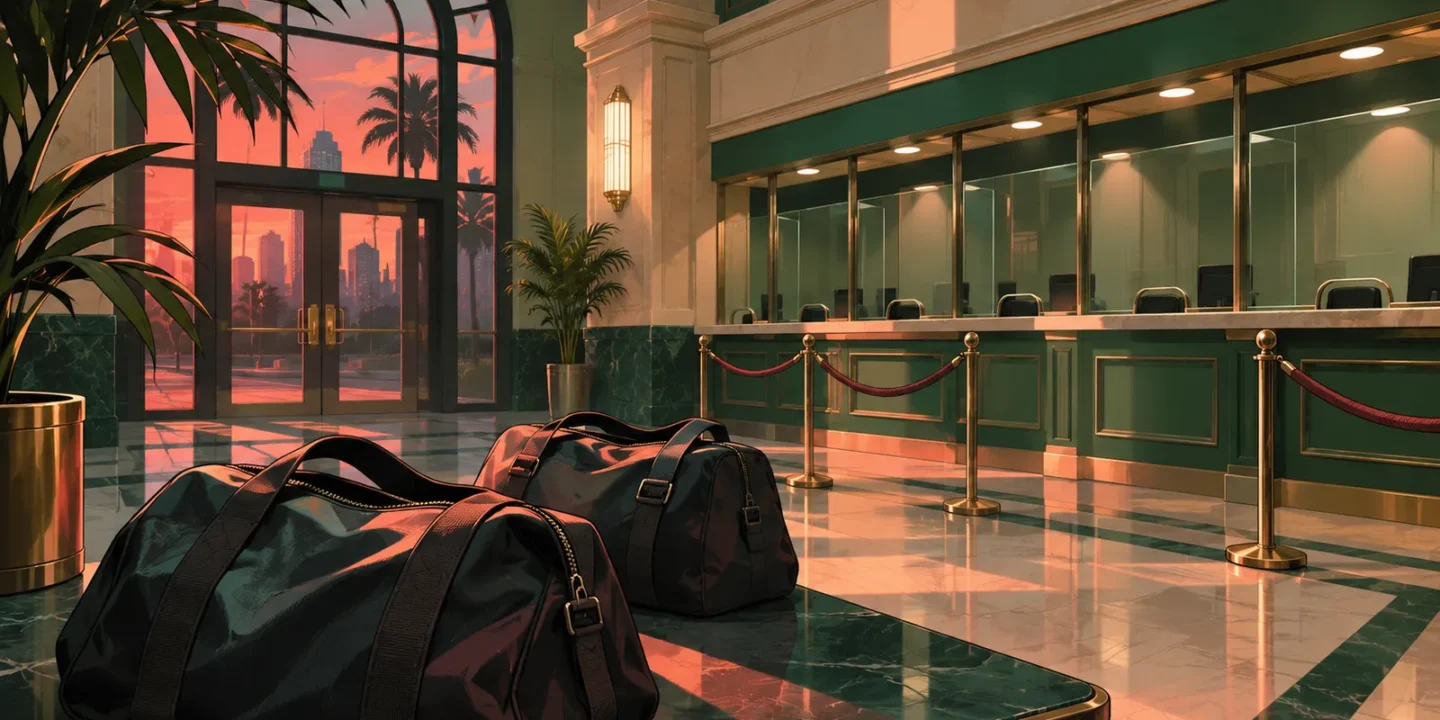
The GTA 6 Fleeca bank robbery is one of the clearest crime scenes associated with Rockstar’s launch gallery. Rockstar’s caption for the official image places Jason and Lucia inside a Fleeca branch, carrying weapons and bags during a hold-up. That establishes a bank robbery scene in the game’s promotional material. It does not, by itself, tell us the mission name, the amount of money earned, the required preparation, or whether the same branch can be robbed repeatedly.
This guide explains the scene, the questions it answers, and the practical details a player should check before following a supposed walkthrough. It is an analysis of published evidence, not a hands-on mission solution. That distinction matters on launch day, when a convincing screenshot can travel alongside an invented objective list. If you want the short answer, Fleeca belongs in the discussion of GTA 6 robberies; a fully verified route and payout need a separate level of evidence.
What the Fleeca scene actually establishes
Rockstar’s own launch-gallery caption describes “Jason and Lucia robbing a Fleeca bank branch, both wearing bandanas and duffel bags, armed with SMGs.” The useful information is the combination of a named business, recognizable protagonists, and a robbery situation. A bank logo on an ordinary street would establish a location. A hold-up inside that business establishes a particular kind of scene.
The image remains a moment rather than an entire sequence. It cannot reveal what happens before the characters enter, what causes the confrontation, or how they leave. Even a bag apparently containing money does not reveal the eventual mission reward. Cash visible during a story sequence can serve the narrative without corresponding directly to a player’s final balance. Treat the picture as strong evidence of setting and action, while keeping the missing sequence separate.
Why the bank’s identity matters

A named bank gives players a concrete reference point. Fleeca is a recognizable fictional financial brand within Grand Theft Auto, so its appearance connects the new setting with the series’ broader commercial world. That connection is useful for understanding the satire and the visual language. It is much less useful for predicting the exact design of a new robbery.
A returning brand does not require a returning floor plan. It also does not require the same security equipment, mission structure, crew arrangement, or reward system found in an earlier game. Think of the brand as the name above the door, not a promise that everything behind the door behaves identically. For navigation, rely on the current game’s business label and surroundings. For tactics, rely on the current objective and actual interaction prompts.
Jason and Lucia’s roles need sequence-level evidence
The picture puts both protagonists in the same criminal situation. That is relevant because GTA 6’s central premise revolves around their partnership. Rockstar’s official overview presents their relationship against a wider criminal conspiracy in Leonida. A shared bank scene fits that premise, but a still frame cannot explain how control passes between them.
One character holding cash while another watches the room may suggest complementary roles within the scene. It does not establish a selectable class, a permanent division of duties, or a cooperative multiplayer mode. The same caution applies to character switching. A trailer edit between two perspectives is not enough to identify the switching rules during a mission. Look for a continuous demonstration, an explicit explanation, or a tested account of the objective before treating a role assignment as a mechanic.
How Raul Bautista fits the discussion
Rockstar’s character material describes Raul Bautista as an experienced bank robber whose appetite for risk can create trouble for his crew. That makes him relevant background when discussing the game’s bank jobs. It does not identify him as the organizer of every robbery image, and it does not connect him automatically to this particular Fleeca branch.
The distinction is straightforward: a character biography establishes a person’s occupation and temperament; a mission introduction establishes that person’s role in a specific job. Players who want to avoid spoilers can stop at the biography. Players seeking a walkthrough should check the exact mission title and opening objective. Linking the Fleeca scene to Raul without that extra connection would turn a reasonable thematic association into an unsupported story claim. Our GTA 6 gangs and crews guide explains the broader network without assuming every criminal contact belongs to one organization.
Is this a story mission or a repeatable activity?

This research pass did not verify the Fleeca encounter’s availability rules. The gallery alone cannot distinguish a mandatory story sequence from an optional job, a replayable mission, or an open-world robbery system. Those categories can look almost identical in a promotional image. Their differences become visible through menus, mission introductions, progression requirements, and what happens after completion.
For a useful answer, ask whether the bank can be entered outside the sequence, whether a mission marker starts the event, and whether returning later restores the same opportunity. A replay option would still be different from a bank that can be robbed freely in the open world. Likewise, a second robbery elsewhere would not prove that every branch supports the activity. Keep the answer specific to the tested branch and the tested mode rather than generalizing from one successful encounter.
What a reliable walkthrough should show
A trustworthy Fleeca walkthrough should begin before the robbery starts. It should identify the mission name, the current objective, any prerequisite, and the relevant platform or control layout. That opening context protects readers from following instructions for a different bank scene. It should also explain whether the guidance contains story spoilers so that readers can choose the amount of help they need.
During the sequence, useful instructions connect each action with an on-screen requirement. If an interaction is optional, the guide should say so. If a route is simply the author’s preference, it should be described as a suggested route rather than the required solution. At the end, the guide should distinguish the mission’s completion payment from bonuses, optional loot, and money already held by the player. A screenshot of a final balance without a starting balance is weak evidence for a payout claim.
Why exact payouts are easy to misreport
A robbery reward can mean several different things in ordinary discussion. Someone may quote the amount seen inside the bank, the amount carried out, the amount divided among characters, or the amount finally credited after the story settles. Those are different measurements. An accurate guide needs to specify which one it is reporting and show how that figure was obtained.
This article therefore does not assign a dollar value to the Fleeca scene. If a future update adds a tested reward, the calculation should begin with a recorded balance and end after all reward notifications have resolved. Optional pickups should be logged separately. If mission replay changes how money is retained, that needs its own explanation. Without those checks, a large number can create an appealing headline while leaving the reader unable to reproduce the result.
Equipment shown is not necessarily equipment required
The weapons, bags, and face coverings visible in a promotional scene describe the scene’s presentation. They do not establish a shopping list. A story mission may provide equipment, restrict choices, or reflect whatever the player brought into it. The image cannot tell us which of those possibilities applies.
Before spending in-game money in response to a guide, compare its equipment instructions with the actual mission prompt. A useful guide should distinguish required purchases from optional convenience items and purely cosmetic choices. It should also say whether equipment carries over from earlier missions. This matters particularly for a new player following a bank guide out of order: advice written for an advanced save can quietly assume access to gear that an earlier save does not have. Exact requirements belong beside the prerequisite, not hidden halfway through a long article.
Police response and the getaway are separate questions

A bank hold-up naturally raises questions about pursuit, but the interior picture cannot answer them. It does not establish the wanted level, the police arrival time, the escape vehicle, or the method used to end the encounter. Nor does a separate police chase image prove that it follows this particular robbery. Promotional galleries frequently group striking moments without presenting a chronological route.
For an actual getaway guide, the important distinction is between a scripted escape and an open pursuit. A scripted route may require reaching a marker or protecting another character. An open pursuit may allow several approaches. A reader needs to know which condition controls progress before choosing a route. Our police and wanted system guide is the appropriate place for broader police coverage; a Fleeca walkthrough should include only the rules demonstrated during this job.
The interior can be analyzed without inventing a map
The bank’s color scheme, counters, and occupied room communicate a recognizable customer-facing financial space. Those details help identify the scene when comparing official images. They are not enough to draw a reliable complete floor plan. A camera sees one direction and may hide doors, corridors, stairs, or objects outside the frame.
For that reason, an illustrated overhead bank map would need to be labeled as a concept unless it was built from verified exploration. A useful practical map should show its entry point, orientation, tested accessible areas, and the purpose of each marked route. If the bank interior changes between free exploration and a mission, the map should name the relevant state. Attractive arrows are not a substitute for that context. The editorial illustrations accompanying this article visualize the theme and should never be used as navigation references.
How this robbery differs from the other scenes
A bank robbery, an armored truck confrontation, and a mall motorbike scene involve different kinds of space. A bank concentrates attention around an interior business. A security truck introduces a moving or roadside target. A mall adds public corridors, multiple levels, and commercial surroundings. Those environmental differences are useful for analyzing the scenes even before a full objective sequence has been checked.
They do not prove three interchangeable money-making activities. The armored truck guide and mall robbery guide explain their own evidence separately. If you arrived here looking for the best robbery to repeat, compare only guides that have verified availability, completion time, failure conditions, and retained reward under similar conditions. A cinematic image cannot supply those measurements, and a faster-looking vehicle does not establish a faster money route.
A spoiler-light way to use this information
You can recognize the Fleeca scene without learning its eventual story outcome. Check the business name, the protagonists involved, and whether your current objective actually points to the bank. If you are simply exploring Leonida, let the game introduce the job before opening a detailed solution. That keeps the scene’s narrative context intact while still helping you distinguish a real mission guide from a speculative article.
If you become stuck, search for the exact wording of the objective rather than only “Fleeca robbery.” An objective-specific answer is more likely to address the blocked interaction you are facing. It also reduces the chance of reading unrelated story spoilers. When reporting a problem, include whether you restarted a checkpoint, replayed a completed mission, or loaded an earlier save. Those circumstances can matter more than the name of the bank when another player tries to reproduce the issue.
Common questions about the Fleeca robbery
Has Rockstar shown a Fleeca hold-up? Yes. Rockstar’s official launch gallery captions one image as Jason and Lucia robbing a Fleeca bank branch, and that caption is the description used in this article. We have not treated a fan-made map marker as official location evidence.
Can you rob every Fleeca bank? That is not established by the scene analyzed here. A single depicted branch does not define the access rules for other locations. Is the reward confirmed in this guide? No tested payout is supplied. Can two people play the robbery together? Two protagonists in the picture do not establish multiplayer support. Is Raul definitely running this job? His bank-robber biography is relevant context, but this evidence set does not verify that connection. Each answer stays limited to what the cited material can support.
What to check when the guide is updated
The most valuable additions will be a verified mission identity, a clear unlock condition, and an objective-by-objective solution captured from the game. Those details should replace the relevant unknowns rather than being mixed into the existing evidence discussion without a date. Screenshots showing required interactions would be more useful than additional cinematic stills, especially for readers who are already at the bank and need a specific next action.
Until those details are independently checked, use this page as an explanation of what the Fleeca scene shows. Its value is the separation between a recognizable robbery and a reproducible walkthrough. The bank name, the shared presence of Jason and Lucia, and the crime setting give us something concrete to discuss. The route, timing, reward, and replay rules deserve equally concrete evidence before they become instructions you rely on.
Related guides
- GTA 6 Heists: Every Robbery Rockstar Has Shown So Far
- Raul Bautista in GTA 6: The Veteran Bank Robber Explained
- GTA 6 Jason and Lucia: The Two Protagonists Explained
- GTA 6 Money: Cheats, In-Game Purchases and Scams to Avoid
- How Not to Lose Money in GTA 6: Cash, Stash and Your BuckMe Account
- Where to Sell Stolen Cars and Loot in GTA 6