



The GTA 6 mall motorbike scene puts helmeted riders inside a shopping center during an armed confrontation. It is one of the most distinctive locations in the launch-gallery discussion because it brings vehicles into a space normally associated with pedestrians, storefronts, and indoor public life. “Mall robbery” and “motorbike heist” are descriptive terms used in this article; this research pass did not verify an official mission title or a complete playable route.
The scene is worth analyzing without turning it into an invented walkthrough. Its setting, vehicle choice, and public surroundings tell us something about Rockstar’s presentation of Vice City. They do not reveal the target, the reward, the unlock requirement, or whether players can revisit the same interior freely. This guide explains those distinctions and shows what to look for when more detailed mission help is available. The accompanying illustrations are imagined editorial artwork, not screenshots of the actual mall.
What has been shown in the mall scene
Rockstar’s own launch-gallery caption describes Jason, wearing a helmet while atop a motorbike, pointing a submachine gun offscreen while two other figures on bikes cover their backs inside a mall hallway, with two armed guards pointing handguns at them in the background. That supports a motorbike action scene in a shopping environment.
They do not identify every rider. A gallery category connected to Jason is useful indexing information, but it is weaker than a clear view or an explicit character description for naming each participant. Helmets conceal faces, and similar clothing can be shared by different characters. The same principle applies to the location: a recognizable retail interior does not automatically settle its official name, exact district, real-world inspiration, or relationship to other buildings shown elsewhere in the gallery.
Why the indoor motorbikes stand out
A motorbike changes the scale of an indoor scene. A corridor designed visually around shoppers suddenly becomes a route for vehicles, making familiar objects such as kiosks, planters, railings, and shop entrances feel like potential obstacles. That contrast helps explain why the image is memorable even without an objective list. The dramatic idea is readable immediately: speed is entering a space associated with slower, more controlled movement.
This is an interpretation of the scene’s composition, not a report of tested collision behavior. We do not know from the still which objects can be moved, broken, or passed through. We also cannot infer the speed at which the riders are traveling. A low camera angle, wheel position, and scattered crowd can communicate urgency without supplying measurable handling information. Any future riding advice should come from the playable sequence rather than from the image’s sense of momentum.
The shopping center is more than a backdrop
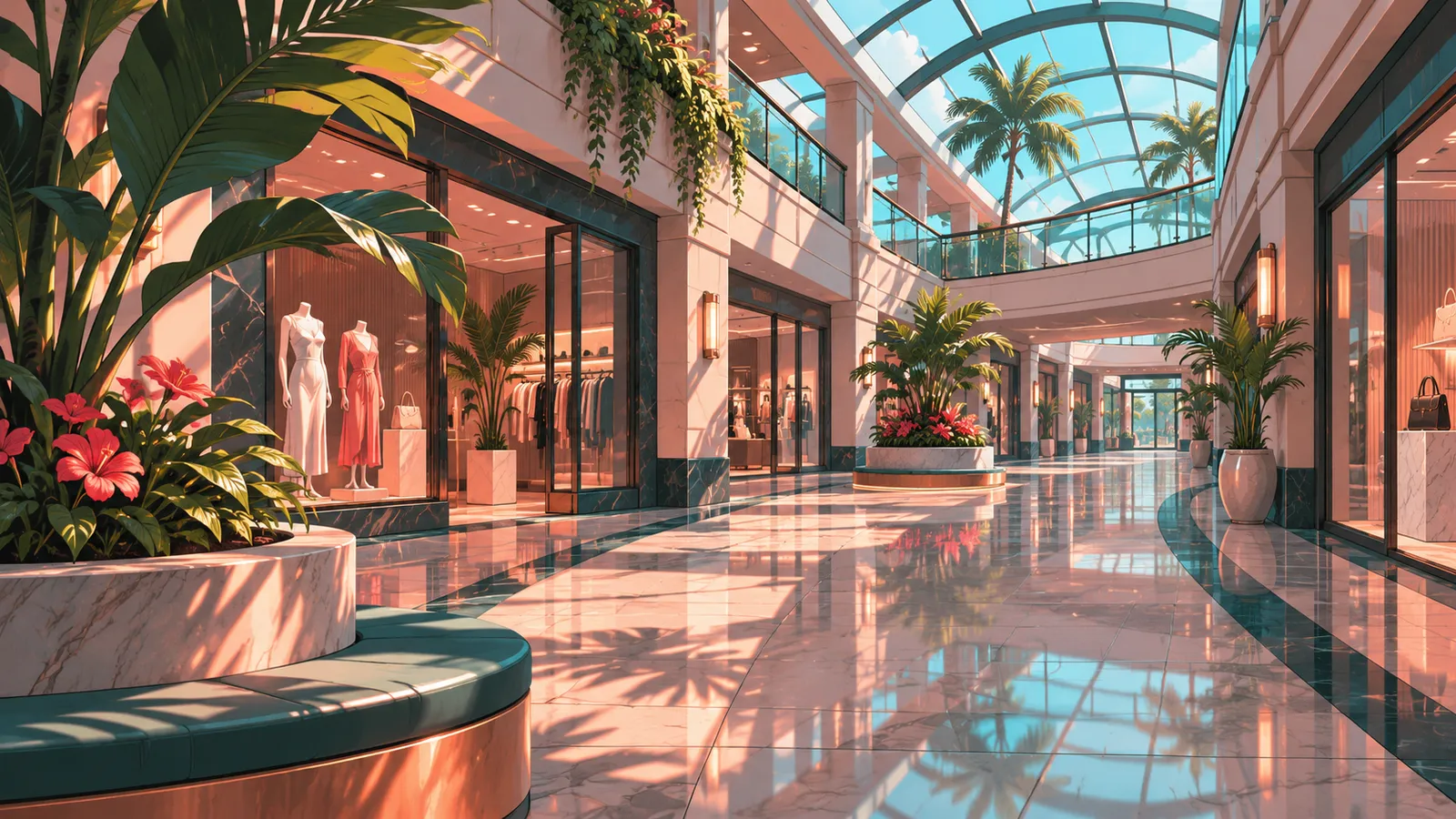
A mall brings together several kinds of public space. Storefronts create rows of recognizable destinations; open corridors create movement between them; atriums and upper levels can make the space visually legible from different viewpoints. In an action scene, those architectural features offer opportunities for framing and contrast. They can also make a location seem larger than the portion that is actually accessible.
The practical question is therefore not simply whether GTA 6 “has a mall.” It is which areas can be entered, under what conditions, and for what purposes. A mission might use a limited section of a larger-looking complex. A cinematic might show a route that ordinary exploration does not expose. Until access is checked, treat the shown corridor as the confirmed setting of the scene, not a complete inventory of shops, floors, entrances, and activities available throughout the building.
Is this definitely a robbery?
The armed riders and guards make a criminal action sequence a reasonable description of the image. The exact objective remains a separate matter. The still does not show a mission briefing, a stolen item, a completion screen, or the sequence that brought the riders indoors. Calling it a mall robbery is a useful topic label, but it should not be mistaken for proof of a specific target or payout.
That distinction helps avoid a common leap: assuming that an upscale retail setting means a jewelry-store heist with smash-and-grab mechanics. A mall can contain many businesses, and an action sequence can take place there for several narrative reasons. A reliable walkthrough should identify what the protagonists are actually trying to do. Until then, this article uses the supplied title while keeping the objective open rather than adding a shop name or loot system that the evidence does not establish.
No official mall name is established here
This research pass did not verify the shopping center’s official in-game name. It also did not establish a real-world building as its exact model. Architectural similarities can be interesting, but resemblance is not a source for a location label. A fictional environment may combine features from several places or change a familiar layout to suit the game.
For readers trying to find the scene, the best future evidence would be an in-game map label connected to the entrance and a continuous route into the relevant interior. A screenshot of a façade alone would be insufficient if several malls share similar architecture. Until that connection is documented, avoid following a supposedly exact map pin based only on fans recognizing a skylight or storefront arrangement. A named, tested route will be more useful than a confident real-world comparison that sends you to the wrong district.
Helmeted riders do not prove a three-player mode
Three people on bikes are three characters in a scene, not evidence of three human players. Story missions can include companions, enemies, and scripted participants without offering multiplayer control. The image also does not establish whether all riders are on the same side throughout the sequence or whether the player can issue them commands.
For a practical mission explanation, the important details are who the player controls, whether that control changes, and what the other riders require from the player. Those answers need a continuous demonstration or a tested walkthrough. GTA 6’s official overview centers Jason and Lucia’s relationship, but that premise does not define every companion arrangement. A caption that names one protagonist should be read as a piece of official organization, not as a complete description of the mission’s playable cast or networking features.
What can be said about the bikes?
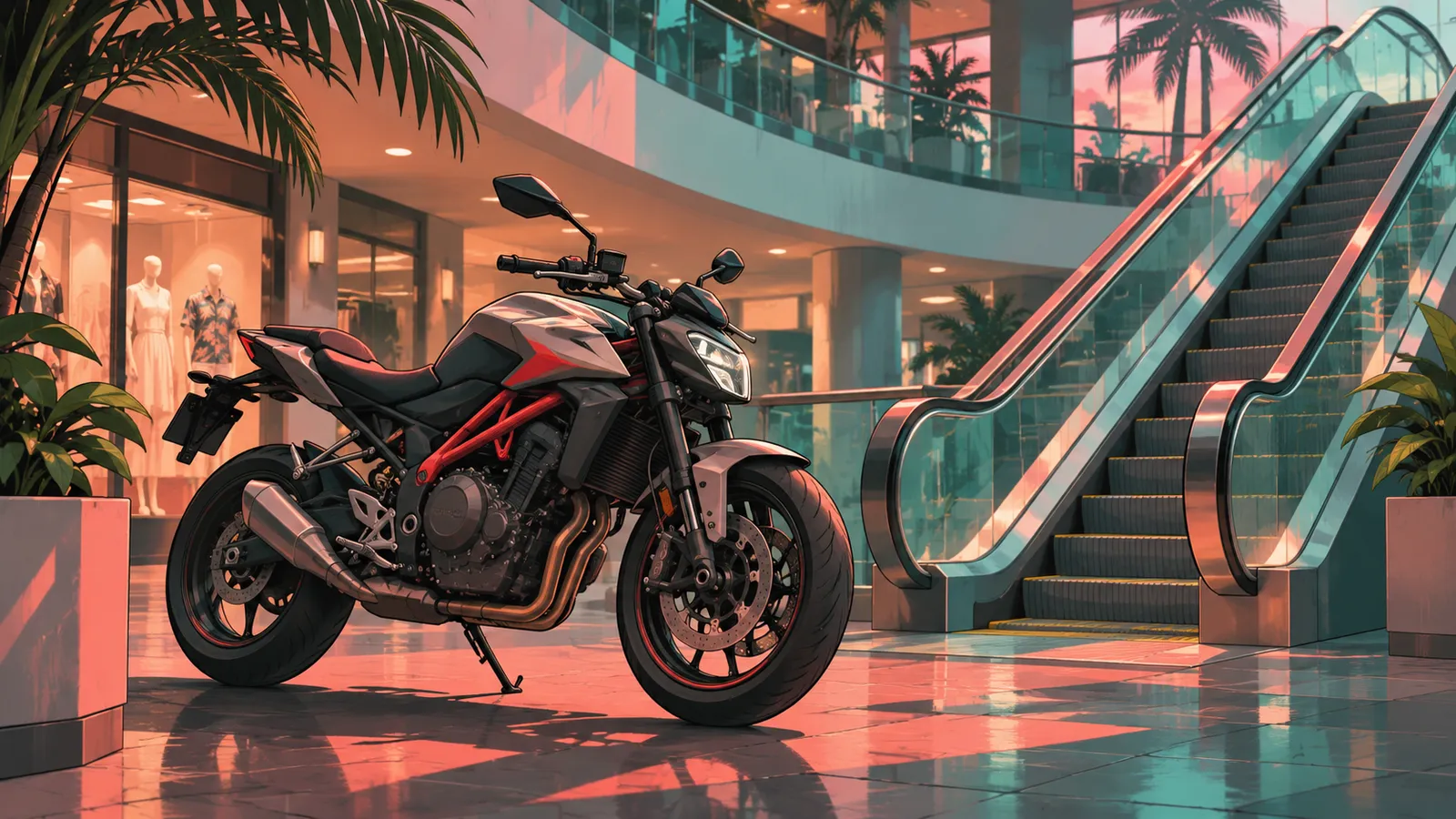
Rockstar’s caption simply calls Jason’s ride a motorbike and the others “bikes.” That is a useful broad vehicle description, especially when distinguishing the mall scene from a separate image of Jason riding a road-going motorcycle. It does not settle the exact manufacturer, model, performance figures, or whether the bikes can be selected before starting the sequence.
Vehicle identification should use a readable in-game name or an explicit official label when possible. Visual guesses can be listed as guesses, but they should not become buying advice. Likewise, the appearance of a particular bike in a story scene does not establish that players must purchase it. A mission may supply vehicles or temporarily restrict access to alternatives. Before any guide recommends spending money, it should show the requirement and explain whether that cost is actually necessary to progress through the objective.
Why a complete indoor route cannot come from one frame
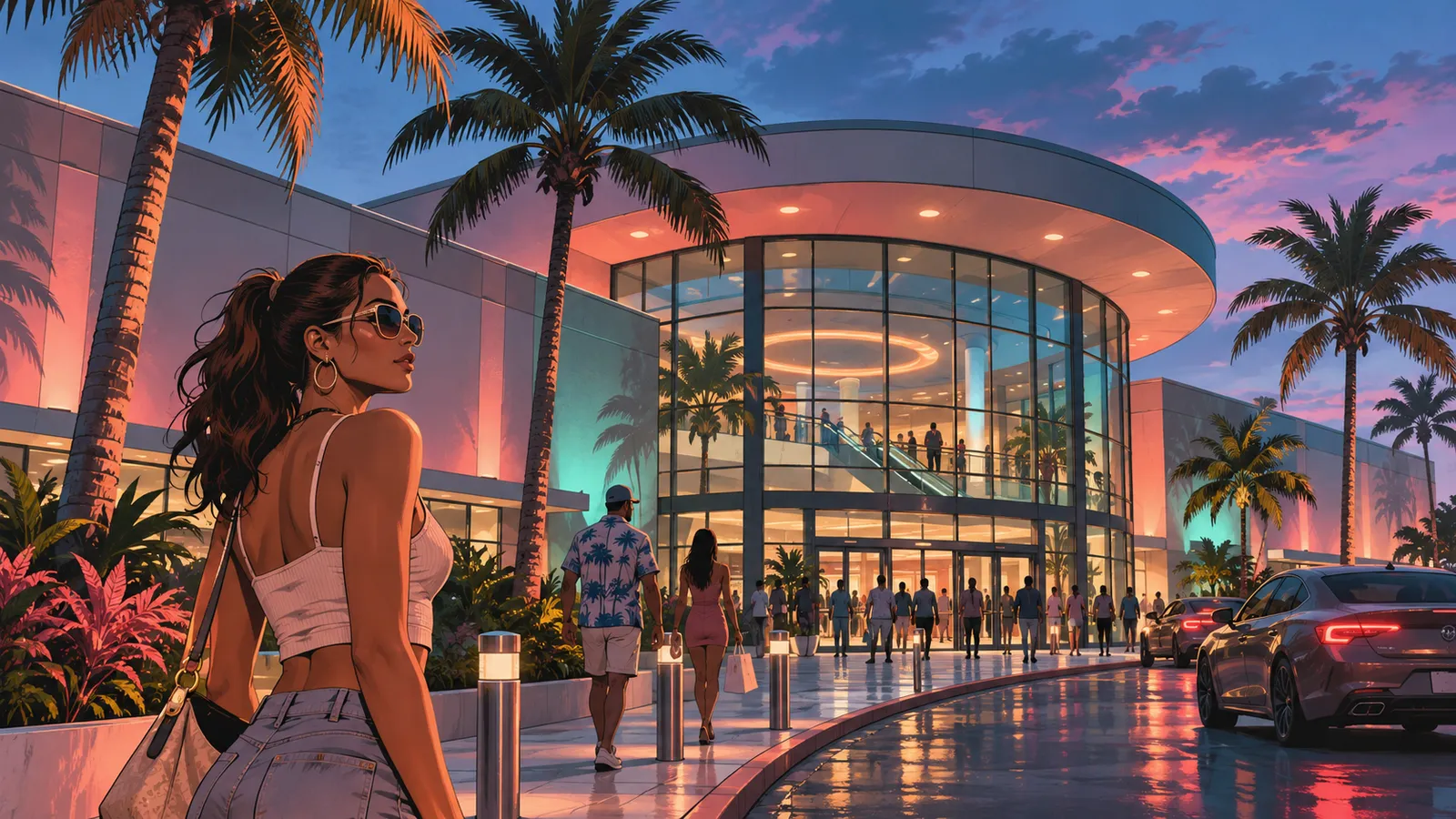
A corridor can imply several possible paths without revealing where any of them lead. An escalator may be decorative, blocked, or part of a route outside the camera’s view. A shop entrance may open into a playable interior or merely provide background detail. A still cannot distinguish these states reliably, even when the scene is shown at high resolution.
A useful map of the mall sequence should therefore begin with a tested entry point and follow the actual objective. It should mark alternative routes only if they have been checked. If a door is accessible during one mission but closed later, that limitation belongs beside the map. This is especially important in a multilevel environment, where a marker can appear close horizontally while being on another floor. Good navigation explains vertical position and recognizable landmarks, rather than drawing a straight line through a building.
What future riding advice should measure
If a walkthrough offers riding tips, it should connect them to specific obstacles and objective conditions. Is the player following another rider, reaching a marker, avoiding damage, or maintaining a required distance? Those are different tasks. Advice that focuses on speed alone can be unhelpful if the real failure condition concerns a companion or a missed trigger.
A tested guide should also identify whether its suggested route is mandatory or simply convenient. It should avoid claiming that a particular jump or shortcut is required unless the game actually demands it. For readers using a different control layout, actions should be named as well as button prompts shown. “Brake before the turn” remains understandable across layouts; an unexplained button symbol does not. These are standards for useful future coverage, not instructions claiming to solve the untested mall sequence now.
Crowds and security need careful interpretation
Shoppers and guards help define the scene as a disrupted public space. Their presence gives the action social context: a commercial setting is being interrupted, rather than a closed arena being used for a vehicle race. That observation is meaningful for the tone of the scene and the contrast between everyday life and crime.
It does not establish how every civilian reacts in the finished game. The image cannot tell us whether behavior is scripted, simulated, or a combination. It also cannot explain detection rules, alarm systems, reinforcement timing, or the consequences of different player actions. A serious guide should describe those systems only after they are observed in context. Until then, crowd behavior belongs in a visual analysis, while security mechanics belong in a tested gameplay explanation. Keeping the two separate makes the eventual guide clearer and easier to trust.
How the mall compares with the bank and truck scenes
The Fleeca bank scene emphasizes a named financial business and an interior hold-up. The Gruppe Sechs truck encounter places security transport within a street confrontation. The mall image brings bikes into a public retail interior. Those differences suggest a range of action settings across the material Rockstar has released.
They do not establish a shared mission chain, a ranking of rewards, or three repeatable robbery types. Each scene needs its own identity and objective record. Comparing their environments is useful because it helps readers recognize which sequence they are looking for. Comparing their supposed earnings would be premature without measurements. If another article promises the mall is the “best heist,” check whether that claim concerns story enjoyment, completion time, money earned, or something else entirely. A recommendation needs a defined basis.
How to get help without spoiling the whole sequence
When you reach a mission involving the mall, begin with the exact objective text. Search or consult a guide for the stage where progress stops, rather than opening a full story summary. That approach is more likely to answer a practical question while preserving the rest of the sequence. It also helps distinguish an interaction problem from a navigation mistake.
If you need to describe the issue, mention the current floor, the visible landmark, the active character, and whether the problem occurred after restarting a checkpoint. Do not assume that another player recognizes your location from “inside the mall.” Large interiors can contain similar corridors, and a guide may cover a different visit. Clear context makes community help more useful and gives an editor enough detail to reproduce a possible bug before publishing a workaround as a universal solution.
Frequently asked questions
Has a motorbike action scene inside a mall been shown? Published descriptions of the official launch image identify helmeted riders and armed guards in that setting. Is the mission name confirmed in this article? No. The supplied title is retained as a topic description. Is the mall’s real-world counterpart known here? No exact identification was verified in this research pass.
Can you ride any motorbike into the mall? The image does not establish free-roam vehicle access. Can you visit every shop? A storefront in a screenshot does not establish an enterable shop. Does the scene prove multiplayer? No. Several characters sharing a scene do not identify the number of human players. Does this guide provide a payout? No tested reward is included. Each of these questions needs evidence beyond the composition of the image itself.
What would make this a complete mission guide?
A complete update should provide the verified mission title, unlock condition, relevant entrance, and objectives in order. It should explain any forced vehicle selection, required companion behavior, and checkpoint-specific problems. A reward section should distinguish story payment from optional gains. A map should reflect the actual accessible route and identify the correct floor wherever vertical navigation matters.
For now, the mall scene is most useful as a concrete example of GTA 6’s contrast between ordinary public spaces and spectacular criminal action. The bikes, guards, and retail corridor make that contrast readable. The target, route, and consequences remain outside the verified evidence used here. Recognize the scene, enjoy the setting, and ask more of any walkthrough that claims to turn one dramatic picture into a complete heist solution. Its instructions should be as specific and reproducible as its headline is confident.